
As we navigate the first half of 2026, the conversation around artificial intelligence has shifted. We have moved past the initial “wow factor” of chatbots and entered what industry leaders are calling the “Year of Truth for AI.” At Smart AI for Work, we’ve been tracking these developments closely to help you stay ahead of the curve.
Predicting AI technology trends in 2026 isn’t about guessing which chatbot will be slightly faster; it’s about identifying the structural changes in how businesses operate. From the rise of “Agentic AI” to the “Cognification” of everyday devices, here is our deep dive into the trends defining the professional world this year.
1. The Rise of Agentic AI: From Chatbots to Do-Bots
The single most transformative trend of 2026 is the shift from Generative AI to Agentic AI.
In 2024 and 2025, we used AI for work primarily to write emails or summarize meetings. In 2026, we are deploying AI Agents—autonomous systems capable of reasoning, planning, and executing multi-step workflows without constant human prompting.
-
What it looks like: Instead of saying “Draft an email to this vendor,” you tell your agent, “Find a new eco-friendly packaging vendor, negotiate a bulk rate within our budget, and draft the contract for my review.”
-
The Impact: Professionals are moving from being “creators” to “orchestrators.” Your value is no longer in doing the task, but in managing the digital assembly line that completes it.
2. Intent-Based Computing: The End of the “Manual” Interface
We are witnessing the “paradigm shift” from writing code and clicking buttons to expressing intent. This is a core pillar of AI for work in 2026.
Software is becoming self-assembling. Modern enterprise platforms are moving toward “Liquid UI,” where the interface changes dynamically based on what the AI predicts you need to do next. Whether you are using a CRM or a design tool, the software “assembles” itself around your specific goal.
Key Prediction: By the end of 2026, “prompt engineering” will be replaced by “intent-based orchestration.” The AI will understand the context of your business goals so deeply that simple natural language will trigger complex technical backend actions.
3. Sovereign AI and the “Cloud 3.0” Evolution
As AI becomes the backbone of the digital economy, Data Sovereignty has moved to the top of the C-suite agenda. Organizations are no longer comfortable sending all their proprietary data to a central public cloud.
Cloud 3.0 is defined by a mix of hybrid, private, and “sovereign” cloud models. Companies are now:
-
Fine-tuning small, highly efficient models (SLMs) on their own secure infrastructure.
-
Prioritizing “Sovereign AI” to comply with new 2026 global data regulations.
-
Moving toward “Edge Intelligence,” where AI processing happens locally on devices to ensure zero-latency and maximum privacy.
4. The Cognification of the Physical Workspace
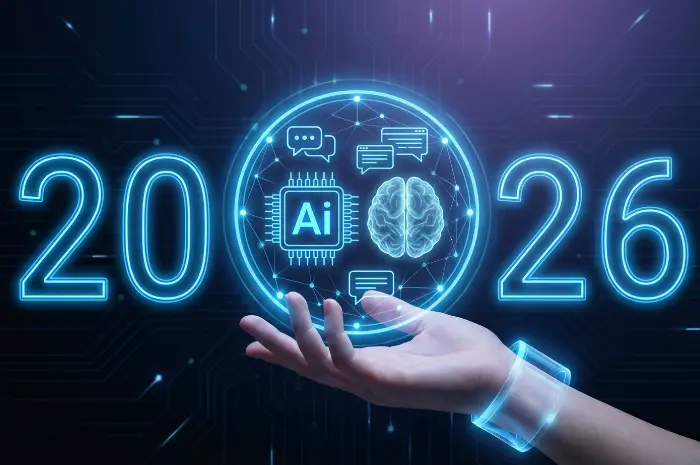
In 2026, AI is jumping out of the screen. The “Internet of Things” (IoT) has evolved into the “Intelligence of Things.”
From office thermostats that optimize energy based on real-time team collaboration patterns to “Physical AI” in warehouses and retail, everything with a power source is becoming intelligent.
-
Humanoid & Modular Robots: We are seeing the first widespread deployment of modular AI robots in professional environments—handling logistics, inventory, and even high-risk maintenance tasks.
-
Vision-Guided Inspection: AI-powered cameras are now the standard for quality assurance in manufacturing and security, detecting anomalies with 99.9% accuracy.
5. AI Literacy as the New “High School Diploma”
The “AI skills gap” was the biggest barrier of 2025. In 2026, AI proficiency is no longer a “nice-to-have” skill—it is a baseline career requirement.
We are seeing a trend where companies prioritize “AI Fluency” over specific role redesign. The most successful professionals are those who have built an “Intelligent Memory”—a personalized knowledge base where they use AI to interpret years of their own professional data, notes, and signals to make faster, better decisions.
6. Real-World ROI: The End of the “Pilot Phase”
In the first half of 2026, the “test-and-learn” phase is officially over. Executives are demanding measurable results.
| Trend | 2024 Context | 2026 Reality |
| Productivity | “It helps me write faster.” | “It reduced operational costs by 40%.” |
| Customer Service | AI Chatbots with 24/7 scripts. | AI Agents that resolve 90% of issues end-to-end. |
| Decision Making | Data visualizations. | Predictive “Decision Intelligence” that forecasts demand. |
7. Synthetic Content and Multimodal Mastery
Multimodal AI—systems that seamlessly understand text, audio, video, and images simultaneously—is the new standard.
In the marketing world, Synthetic Content is no longer a shortcut; it’s a strategy. Brands are using AI to create thousands of “hyper-personalized” variations of ad campaigns in seconds, each tailored to a specific demographic’s visual and linguistic preferences.
How to Prepare for the Rest of 2026
At Smart AI for Work, we believe the best way to predict the future is to build it. To stay competitive in this “Year of Truth,” we recommend three immediate actions:
-
Audit Your Friction: Identify where your team spends more than two hours a day on “administrative execution.” These are the primary candidates for Agentic AI integration.
-
Secure Your Data Moat: Start structuring your intellectual capital now. The collective knowledge of your company is your greatest asset in an AI-driven world.
-
Adopt a “Human-in-the-Loop” Governance Model: As agents become more autonomous, your role as a “validator” becomes critical. Establish clear audit logs and oversight protocols today.
Final Thoughts: The Future is Partnered
The defining trend of AI technology in 2026 is the realization that AI isn’t replacing the worker—it’s replacing the work. By automating the routine, we are finally freeing the human spirit to focus on high-level strategy, ethics, and genuine connection.
Stay tuned to www.smartaiforwork.com for deep dives into the specific tools mentioned in this report. The smarter way to work is no longer a dream—it’s the new reality.
FAQ: AI Trends 2026
What is “Agentic AI”?
Agentic AI refers to systems that can autonomously plan and execute complex tasks (like booking travel or managing a supply chain) rather than just responding to simple text prompts.
Will AI replace my job in 2026?
While AI is automating specific tasks, the demand for professionals who can manage and oversee AI systems is at an all-time high. AI proficiency is becoming a mandatory career skill.
What is Sovereign AI?
It is the practice of countries and companies building and hosting their own AI infrastructure and data models to ensure they comply with local laws and maintain total control over their proprietary information.