
In the volatile world of SaaS, surviving for over eight years is an achievement, but maintaining a “top-of-mind” status is an entirely different story. First launched in 2018 by Alexander Isora, Unicorn Platform took the industry by storm with its “no-code, no-fuss” philosophy tailored specifically for startups. However, as we move into 2026, a critical question arises: Can a simple tool hold its own against giants that are weaponizing AI every single day?
This article analyzes Unicorn Platform’s remarkable journey of adaptation, the strategic updates that have swept ProductHunt awards, and its true position in the modern website builder landscape.
1. The 2018-2026 Context: When Simplicity Was No Longer Enough
In 2018, Unicorn Platform emerged as a savior for non-technical founders. At the time, Webflow was too complex, while Wix felt cluttered with outdated templates. Unicorn Platform chose a narrow niche: Landing pages for Startups and SaaS.
However, by the 2024-2025 period, the wave of generative AI for text and imagery completely shifted user expectations. A smooth drag-and-drop editor was no longer sufficient. Users wanted a partner that could understand a business concept and automatically bring it to life.
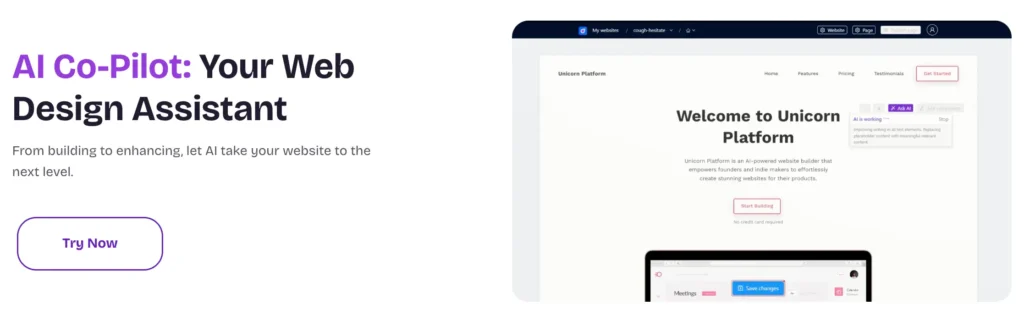
Facing the risk of being phased out by next-gen AI tools, Unicorn Platform made a giant leap in 2026: Transforming from a “Tool” into an “AI Agent” for website construction.
2. Strategic “Big Updates” Changing the Game
To maintain its perfect TrustPilot scores and consistent “Product of the Year” rankings on ProductHunt, Unicorn Platform rolled out three new technological pillars:
2.1. Magic Build 3.0: From Concept to Website in 30 Seconds
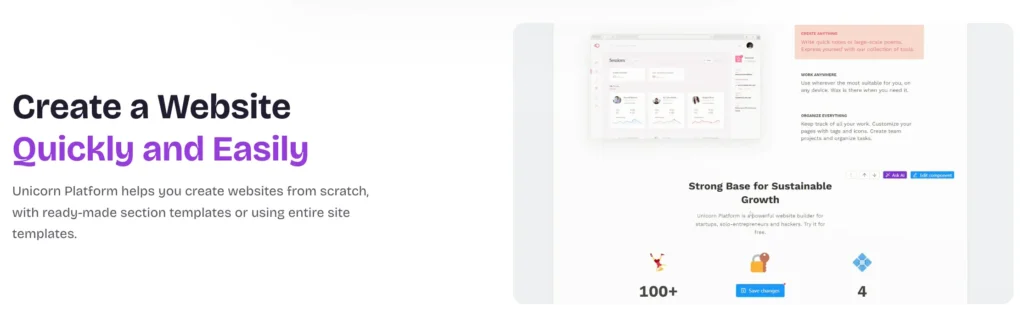
It’s no longer about selecting blocks and swapping text. With the 2026 version, users simply enter a prompt describing their business model. The AI system then automatically:
- Performs a target audience analysis.
- Suggests a landing page structure optimized for conversion (utilizing AIDA or PAS frameworks).
- Generates SEO-ready copywriting and exclusive brand-aligned imagery.
2.2. Deep Integration Ecosystem
One of Unicorn Platform’s historical weaknesses was scalability. Recent updates have addressed this by introducing:
- Native CMS: Manages blogs and dynamic data with a power comparable to Webflow but with ten times the ease of use.
- AI-Driven Analytics: Instead of just displaying raw numbers, the AI provides actionable advice: “Your headline has a high bounce rate; try this suggested alternative…”
2.3. Performance and Localization
Page load speed has always been Unicorn’s crown jewel. By optimizing clean code and leveraging a global CDN network, websites built on Unicorn Platform 2026 achieve near-perfect Lighthouse scores (98-100).
3. Market Positioning: Where Does Unicorn Platform Stand?
To understand Unicorn Platform’s value proposition, we must weigh it against two extremes: Wix (General/Multi-purpose) and Webflow (Professional/Complex).
Vs. Wix: The Elegance of Sophistication
Wix is like a massive supermarket—it has everything, but it can be chaotic. For a startup requiring minimalism, modern aesthetics, and speed, Wix often produces heavy, “cookie-cutter” sites unless meticulously customized.
- The Edge: Unicorn Platform wins on focus. Every font, whitespace, and UI component is designed to fit the “SaaS aesthetic.”
Vs. Webflow: Freedom vs. Efficiency
Webflow is the Photoshop of the web. It is powerful but comes with a steep learning curve.
- The Difference: If you are an agency needing to design complex interactions and custom animations, choose Webflow. But if you are a founder needing to launch an MVP in two hours to test the market, Unicorn Platform is the absolute winner.
Quick Comparison Table:
| Criteria | Unicorn Platform | Webflow | Wix |
|---|---|---|---|
| Deployment Speed | Ultra-fast (Minutes) | Slow (Days/Weeks) | Moderate |
| Learning Curve | Low (No training) | High (Specialized skill) | Low |
| AI Support | Comprehensive Agent | Assistant-based | Basic |
| Aesthetics | Modern, Minimalist | Absolute Customization | Diverse but Generic |
4. Why Does Unicorn Platform Continue to Thrive?
The secret lies in “Community” and “Empathy.”
They don’t try to serve everyone; they serve the busy. Their ProductHunt accolades don’t just stem from features, but from the support of the “Indie Hacker” community—people who view Unicorn Platform as a staple of startup culture.
By maintaining fair pricing and a personalized customer support policy (rather than soulless chatbots used by major corporations), they have sustained high TrustPilot ratings for years.
5. Conclusion: What Is Your Choice for 2026?
Unicorn Platform is no longer just a website builder; it is a “laboratory” for startup ideas. The synergy of refined aesthetics and the power of 2026 AI has allowed the platform to step out from the shadow of being a “simple no-code tool” to become a strategic solution.
The Reviewer’s Verdict:
- Choose Unicorn Platform if you prioritize: Speed, Modern Aesthetics, and Cost-Efficiency.
- Skip it if you need: To build a massive e-commerce empire like Amazon or a highly complex web application.
In the AI era, the tool that helps you realize your idea the fastest is the winner. And Unicorn Platform is doing that better than ever.
Have you experienced the new Magic Build feature yet? Share your thoughts in the comments below!